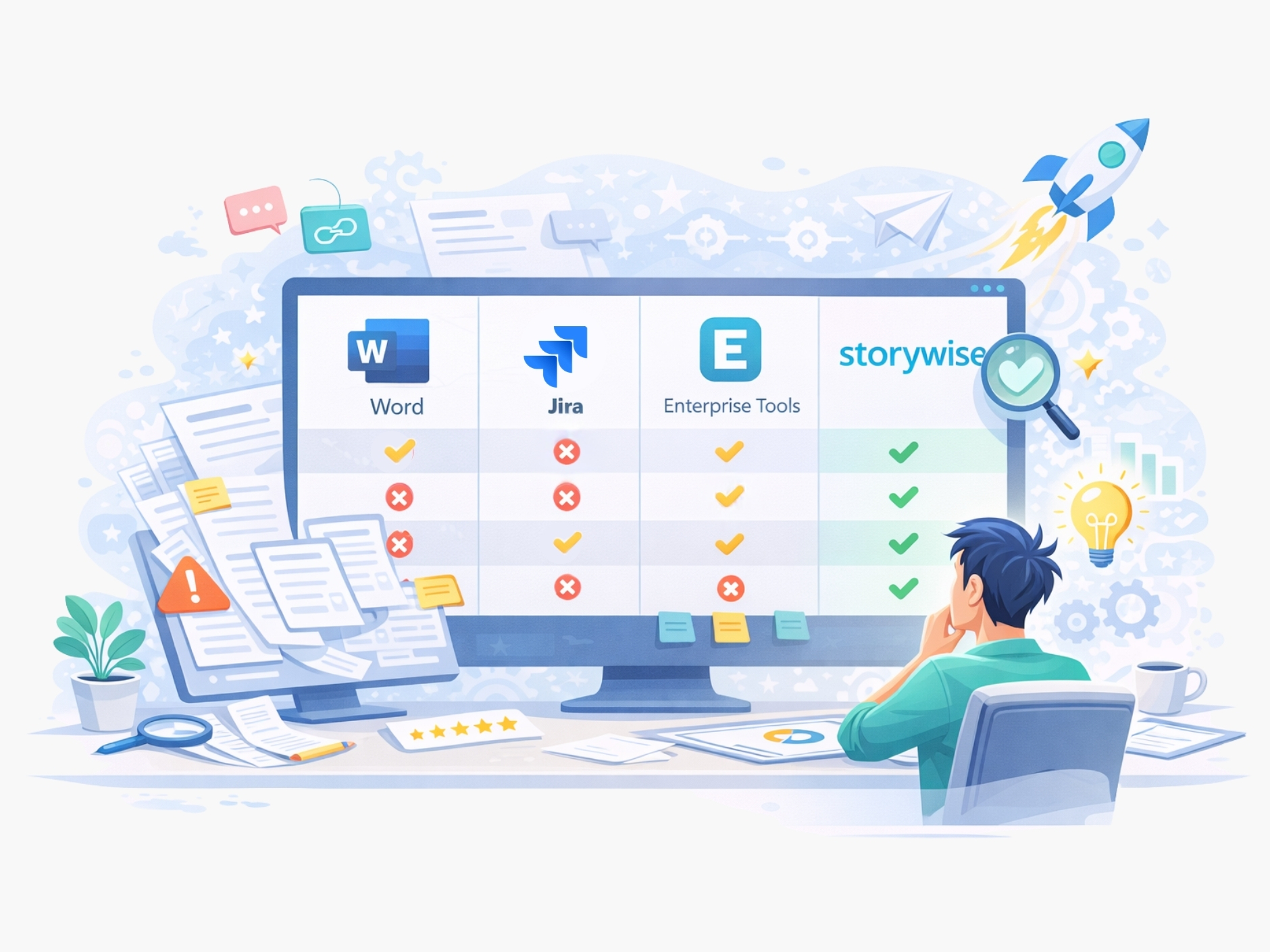
Choosing the right tool for managing software requirements can feel like navigating a maze. The market is flooded with options, from simple document editors to complex enterprise suites. For agencies and development teams, the stakes are high. Pick the wrong tool, and you risk communication breakdowns, scope creep, and lost revenue. Pick the right one, and you can streamline your workflow, improve accuracy, and deliver better products faster.
But how do you know which one is right for you? In this comparison, we break down some of the most popular tools on the market, analyzing their strengths, weaknesses, and suitability for agile teams. We’ll look at criteria like ease of use, automation capabilities, integration, and how well they support the unique needs of modern software development.
1. Traditional Document Tools (Microsoft Word & Google Docs)
Let’s start with the tools everyone knows. For many agencies, Microsoft Word or Google Docs are the default starting point for requirements.
Strengths:
-
Accessibility: Everyone knows how to use them. There is zero learning curve.
-
Flexibility: You can write anything in any format you want.
-
Collaboration: Google Docs, in particular, offers excellent real-time commenting and editing features.
Weaknesses:
-
Lack of Structure: Requirements are just text on a page. There is no data structure, making it impossible to track dependencies or automatically calculate costs.
-
Version Control Nightmares: Managing changes involves saving multiple files (v1, v2, v2_final), which leads to confusion about which version is current.
-
No Integration: Transferring requirements to a project management tool like Jira is a manual, copy-paste process prone to errors.
Best For: Very small, simple projects where formal requirements management isn’t necessary.
2. General Project Management Tools (Jira & Trello)
Many teams try to skip the proposal phase and write requirements directly into their project management tools.
Strengths:
-
Development Ready: These tools are where the work happens. Writing requirements here means they are ready for the dev team immediately.
-
Agile Focus: Built specifically for sprints, backlogs, and agile workflows.
Weaknesses:
-
Not Built for Proposals: These tools are designed for execution, not sales. They lack features for estimating costs, comparing budget options, or generating client-facing documents.
-
Client Unfriendly: Inviting a client into a raw Jira backlog can be overwhelming and confusing for non-technical stakeholders.
-
Fragmented Planning: It’s difficult to see the “big picture” of a project scope when it’s broken down into hundreds of individual tickets from day one.
Best For: Internal product teams managing an ongoing backlog, rather than agencies pitching new projects.
3. Dedicated Requirements Management Enterprise Suites (e.g., IBM DOORS, Jama Connect)
On the other end of the spectrum are heavy-duty enterprise tools designed for complex systems engineering.
Strengths:
-
Robust Compliance: Excellent for industries with strict regulatory requirements (aerospace, medical devices).
-
Deep Traceability: unparalleled ability to trace requirements through complex hierarchies.
Weaknesses:
-
Overwhelming Complexity: These tools often have a steep learning curve and a clunky, outdated user interface.
-
High Cost: The pricing is often prohibitive for small to mid-sized agencies.
-
Slow Implementation: Setting them up can take months, slowing down agile teams who need to move fast.
Best For: Large enterprises building safety-critical hardware or software systems.
4. Storywise: The Modern Choice for Agile Agencies
Storywise bridges the gap between the flexibility of documents and the structure of project management tools. It is built specifically for the pre-project phase—proposal creation and requirements engineering.
Strengths:
-
AI-Powered Automation: Unlike any other tool on this list, Storywise uses AI to generate structured user stories and epics from raw client briefs. This saves hours of manual typing.
-
Structured Data: Every requirement is a data object. This allows for automatic cost calculations, ensuring your estimates are always accurate.
-
Client-Facing Clarity: You can export professional, easy-to-read proposals in PDF or Word formats, or use the side-by-side comparison view to help clients choose between different budget options.
-
Seamless Integration: Once a proposal is won, Storywise syncs perfectly with Jira or other project management tools. You get the best of both worlds: a great sales tool and a clean handoff to development.
Weaknesses:
- Niche Focus: It is specialized for software development and might not be suitable for non-technical industries like construction or general marketing.
Best For: Software agencies, development shops, and product managers who want to equip their offering agencies with Storywise, ensuring they receive consistently well-structured and truly comparable software proposals.
Comparison Summary
| Feature | Word/Docs | Jira/Trello | Enterprise Tools | Storywise |
|---|---|---|---|---|
| Ease of Use | High | Medium | Low | High |
| AI Automation | None | Limited | Possible (varies by tool) | Advanced |
| Cost Estimation | Manual, error-prone | Manual | Available in some advanced solutions | Automated & Accurate |
| Client Presentation | Manual Formatting | Poor | Technical | Professional Exports |
| Dev Integration | Manual Copy-Paste | Native | Complex | Seamless Sync |
Conclusion: Why Structure Wins
While general-purpose tools like Word and Jira have their place, relying on them for requirements engineering is often a false economy. The time you “save” by not learning a new tool is lost ten times over in manual data entry, error correction, and confusing client communications.
For modern agencies that need to move fast without breaking things, Storywise offers the perfect balance. It provides the structure you need to be accurate, the AI automation you need to be fast, and the integrations you need to keep your development team happy.
Stop wasting time on manual requirements.
Experience the difference a dedicated, AI-powered tool can make for your
agency. Try Storywise today and start
building better proposals in half the time.